
Property managers usually don’t have a marketing problem because they lack operational skill. They have one because operations never leaves time for marketing.
Cleaning, guest messages, maintenance, and owner reporting fill the week. The work that actually grows the company — a brand owners trust, listings that perform, a direct-booking channel, and a way to sign new management contracts — often sits unfinished. That is the gap Cavmir is built to fill.
Cavmir is a marketing agency for short-term rentals, boutique hotels, and the management companies that run them. It is not a property manager, and it does not take over operations. The team owns the demand side: brand, direct bookings, owner acquisition, and the marketing work an in-house team often does not have bandwidth to run.
How the Cavmir system is built
Cavmir runs a full engagement through what it calls the 12-Step System — a coordinated marketing program that covers the brand, the rooms, the listings, a website, search, social, and ads. The idea is that each step compounds on the last, so photography, distribution, and demand generation work as one system rather than as disconnected vendors. Cavmir also notes that clients do not need all twelve steps, and that packages can be built around the property.
The first layer is the property and the brand. That includes a property identity (name, logo, brand voice, and guidelines), interior direction designed to photograph well and support the guest experience, a 200-point property audit covering guest experience, safety, amenities, smart technology, and operational readiness, and magazine-quality photography and drone footage. Cavmir describes photography as the most important revenue driver in the sequence.
The second layer is how the property is sold. Cavmir says it lists and optimizes properties across Airbnb, Booking.com, VRBO, Google, Expedia, and more than 55 additional booking channels — 60+ in total — and uses launch sequencing it calls algorithm engineering, with 500 or more calibrated factors, to improve priority on Airbnb.
The third layer is the booking stack. Cavmir can unify channels through a property management platform, but for managers who already have a PMS, the arrangement is different: the existing system stays in place, and Cavmir works on top of it. The direct-booking website is built as a branded site with an integrated booking engine, on a domain the operator owns. Cavmir’s property-manager materials are clear on this point: the website, the content, and the guest list belong to the client, and they stay if the engagement ends.
The fourth layer is demand after the site is live: Google Business Profile and local search, influencer marketing, paid ads, SEO, social media, and email, plus professional property video for social, ads, and booking pages. On its homepage, Cavmir also includes generative engine optimization (GEO), so properties can be found when travelers ask AI tools such as ChatGPT, Gemini, Perplexity, and Google’s AI where to stay.
Cavmir is based in Miami and says it works in markets worldwide. It does not charge a commission on bookings or take a share of owner commissions. Managers pay a retainer, and operations, pricing, and guest messages stay with the operator’s team.
How property managers use the system
A management company grows in two ways: more doors, and fuller calendars on the doors it already runs. Cavmir’s work for property managers treats those as two different jobs.
For growth, the system is built around a company brand owners can trust, a website designed as an owner-acquisition funnel, local SEO and Google presence, and proof that helps a manager stand out when an owner is comparing companies. For performance, it covers a consistent presentation standard, professional photography, listing optimization across OTAs, and a direct-booking channel across the portfolio.
Cavmir positions this work for managers running 5 to 100+ doors. It does not replace an in-house marketing hire when one already exists. In the model Cavmir describes, the in-house person can keep brand voice, owner relationships, and tactical execution, while Cavmir handles technical SEO, paid media, design and content production, the direct-booking website, and the longer-form content engine.
Access to the PMS is limited. Cavmir asks for a read-only user or team seat that can see listings, calendars, reviews, and reporting. It says it does not take the owner seat and does not change operational settings, pricing rules, channel connections, or trust accounting. Monthly reporting is framed around numbers a management company actually uses, including direct-booking percentage, cost-per-acquired-owner, and net-of-commission revenue per door.
The tools that support the stay
Marketing can fill the calendar. The stay itself still depends on the operations stack inside the property: pricing, access, cleaning, guest information, and the in-room experience.
Alongside its agency work, Cavmir publishes an independent Vendors & Suppliers directory for those tools. Cavmir describes the guide as having no affiliate links and no rankings-for-pay, and says it takes no affiliate commissions on the listings.
GuestBox, Cavmir’s recommended in-room TV concierge
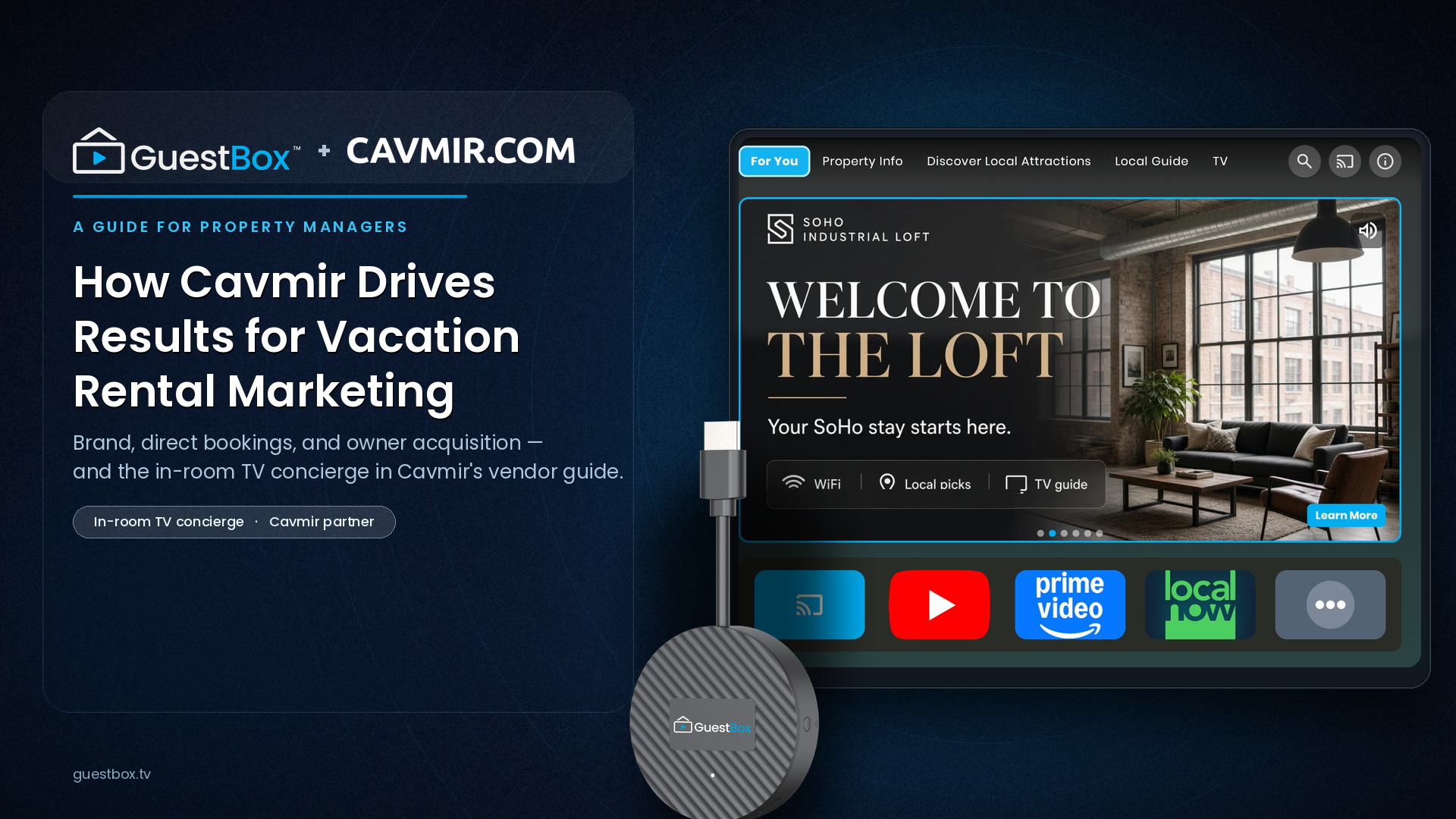
In that directory, GuestBox is listed in the in-room TV concierge category and labeled a Cavmir partner. Cavmir’s own write-up describes GuestBox as a plug-and-play TV system for vacation rentals that greets guests by name, answers their questions, and turns the TV into a new revenue stream. Its “Cavmir take” on the listing is direct: a TV concierge that puts the welcome, the house guide, and the upsells on the biggest screen in the room, and a good fit for hosts and managers who want late checkouts and add-ons without a front desk.
You can see GuestBox in Cavmir’s vendor guide.
That matches how GuestBox is built to help hosts and property managers once a guest has already booked. GuestBox is a dedicated device that connects to a TV’s HDMI port, so the experience is consistent from stay to stay and cannot be removed the way a downloadable app can. When the TV comes on, guests can be greeted by name, with Wi-Fi details and stay information already on screen. The same interface can hold house rules, checkout steps, and local recommendations — a digital guest guide on the TV.
With TV Wake, GuestBox can turn the TV on at the right moment, including when a guest arrives, so the welcome is waiting instead of a blank screen. Hosts can also promote upsells and local activities on the TV; guests scan a QR code to book options such as late checkout, tours, or other add-ons. GuestBox integrates with major activity booking sites, including Viator, GetYourGuide, and Klook, so properties can offer local experiences and earn commissions on those bookings.
Streaming is part of the same experience. Guests can use their favorite apps, and GuestBox automatically logs them out and clears personal data after checkout. Everything is managed from one cloud dashboard. Reservations can sync from Airbnb or more than 40 property management systems, so welcome screens and stay details update automatically. Property branding — logo, colors, and layouts — can be customized across every TV.
GuestBox is available worldwide, is used by 3,516+ registered properties, and comes with a 30-day money-back guarantee.
See GuestBox in action
Cavmir’s system is built to help a property get found, trusted, and booked. GuestBox is built for what happens after the guest walks in. If you would like to see a branded welcome screen, TV Wake, digital guest information, and in-room upsells on a real GuestBox TV, you can schedule a live demo.