
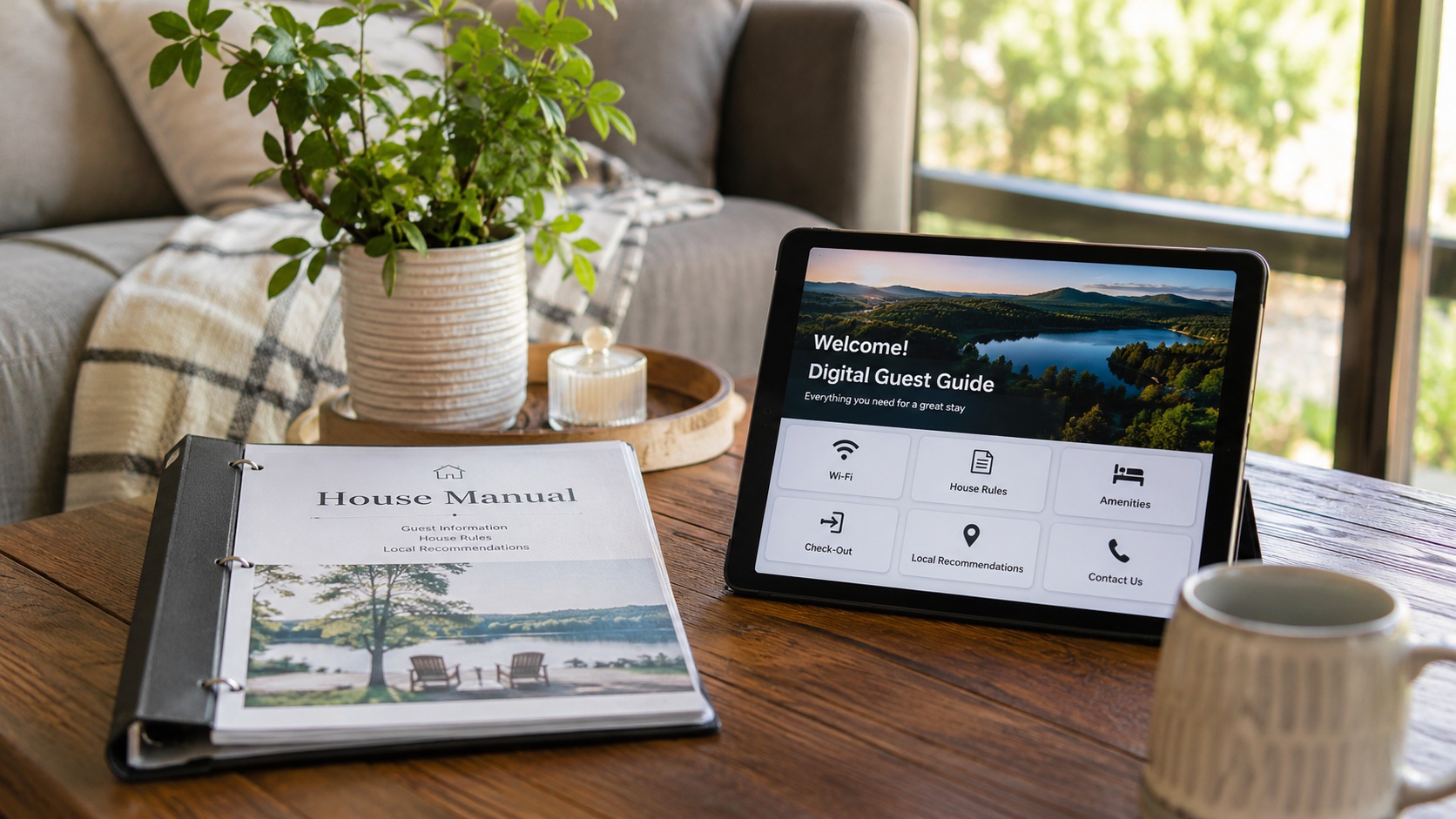
Every vacation rental guest needs information.
They need to know the Wi-Fi password, understand the house rules, find the checkout instructions, and learn how to use the property’s amenities.
For years, most hosts provided these details through a printed house manual.
A binder on the coffee table. A few pages beside the television. Maybe a laminated sheet near the entrance.
It worked.
But as vacation rentals become more connected, property owners have another option: digital property guides.
These guides make important information available through a phone, tablet, website, QR code, or even the property’s television.
So, which works better?
The answer depends on your property, your guests, and how you want to manage the guest experience.
Let’s compare both options.
1. What Is a Printed House Manual?
A printed house manual is a physical document that contains important information about a vacation rental.
It usually sits somewhere guests can easily find it, such as a living room table, kitchen counter, or entryway.
A typical house manual includes:
- Wi-Fi name and password
- Check-in and checkout instructions
- House rules
- Appliance instructions
- Parking information
- Emergency contacts
- Local restaurant recommendations
- Nearby attractions
- Property-specific information
The main advantage is simplicity.
Guests can pick it up, open it, and read the information without needing a device or internet connection.
For smaller properties with straightforward instructions, a printed manual can still be useful.
However, it also has limitations.
2. What Is a Digital Property Guide?
A digital property guide provides the same type of information in an online or electronic format.
Instead of reading a physical booklet, guests access the information through a digital device.
This might be:
- A mobile-friendly website
- A downloadable guide
- A QR code
- A guest information app
- A digital welcome page
- A connected TV interface
Digital guides can include text, images, videos, clickable links, maps, and other interactive information.
For example, a guest could open a guide, tap a restaurant recommendation, and view its location.
A host could also update the checkout instructions or Wi-Fi details without printing a new manual.
This makes digital guides especially useful for property owners who want to keep information organized and easy to maintain.
3. Printed Manuals vs Digital Property Guides
Both options help guests find important information, but they work differently.
| Feature | Printed Manual | Digital Property Guide |
| Access | Physical booklet or pages | Phone, tablet, TV, or other device |
| Updates | Requires reprinting or replacing pages | Can be updated digitally |
| Internet required | No | Usually, depending on the format |
| Photos and videos | Limited | Can include multimedia |
| Interactive links | No | Yes |
| Local recommendations | Can become outdated | Easier to update |
| Multiple properties | Requires separate copies | Can be managed digitally |
| Printing costs | Ongoing when information changes or copies need replacing | No physical printing required |
| Guest convenience | Easy to pick up and read | Easy to access when designed well |
The biggest difference is flexibility.
Printed manuals are physical and straightforward.
Digital guides are easier to update, expand, and share across different devices.
4. Which Is More Convenient for Guests?
Convenience is one of the most important parts of the guest experience.
Guests don’t want to spend time searching for basic information.
They want quick answers.
With a printed manual, guests need to locate the booklet and find the correct section.
With a digital guide, they may be able to access the information through a link or QR code.
For example, a guest who wants to know the checkout time can open the guide on their phone instead of searching through several pages.
However, digital access needs to be simple.
If guests have to download an app, create an account, or navigate a confusing website, the guide may become more frustrating than helpful.
The best digital guides make information easy to find with only a few taps.
5. Which Is Easier for Property Owners to Update?
This is where digital property guides have a clear advantage.
Imagine changing your Wi-Fi password.
With a printed manual, you need to update the information, print a new page, and replace the old version.
If you manage several properties, you may need to repeat the process across multiple locations.
With a digital guide, you can update the information in one place and make the revised version available to guests.
The same applies to:
- Checkout instructions
- Parking details
- House rules
- Restaurant recommendations
- Local attractions
- Property contact information
- Seasonal information
This can save time and help prevent guests from receiving outdated instructions.
6. What About Guests Without Reliable Internet?
This is one area where printed manuals still have an advantage.
A physical guide does not require Wi-Fi, mobile data, or a working device.
That can be useful in remote vacation rentals or properties with unreliable internet connections.
Digital guides, on the other hand, usually require some form of internet access.
Hosts can reduce this limitation by providing Wi-Fi instructions at check-in and making essential information available in more than one way.
For example, a small printed card with the Wi-Fi details and emergency contact information can support a larger digital guide.
The goal is to make sure guests can access important information even when technology doesn’t work as expected.
7. Which Creates a Better First Impression?
A printed manual can feel personal.
A well-designed booklet with property photos, a welcome note, and carefully selected recommendations can make guests feel that the host has prepared something specifically for them.
Digital guides offer a different kind of experience.
They can use branded designs, welcome messages, images, videos, and organized sections to make information feel more modern.
They can also be accessed before arrival, allowing guests to review important details before they even reach the property.
Neither format automatically creates a better impression.
What matters is how clearly the information is presented and how helpful it is to the guest.
8. Which Is Better for Sharing Local Recommendations?
Local recommendations can make a vacation more memorable.
Guests often want to know where to eat, what attractions to visit, and which activities are worth trying.
Printed manuals can include restaurant names, addresses, and suggestions.
But local businesses change.
Restaurants close, opening hours shift, and new attractions appear.
A printed recommendation may become outdated without the host realizing it.
Digital guides make these updates easier.
Hosts can add links to restaurant websites, maps, booking pages, and local attractions.
They can also update recommendations based on the season or the type of guest staying at the property.
This makes digital guides particularly useful for hosts who want to keep their local recommendations relevant.
9. Which Helps Reduce Repetitive Guest Questions?
Both formats can reduce guest questions if the information is complete and easy to understand.
A printed manual gives guests a place to look for answers.
A digital guide can make those answers easier to organize and access.
For example, hosts can create separate sections for:
- Before arrival
- Check-in
- Wi-Fi and internet
- Appliances and amenities
- Local recommendations
- House rules
- Checkout
Instead of sending the same instructions repeatedly, hosts can direct guests to the relevant information.
However, a guide should not replace personal communication when a guest needs assistance.
It should handle common questions while allowing hosts to focus on more important requests.
10. Which Is More Practical for Multiple Properties?
For hosts managing one property, maintaining a printed manual may be relatively easy.
But the workload changes when managing several rentals.
Each property may have different Wi-Fi details, parking instructions, house rules, appliance information, and local recommendations.
Keeping multiple printed manuals accurate can become time-consuming.
Digital guides offer more flexibility.
Property managers can organize information by location and update the relevant guide without replacing physical documents.
Some platforms also support centralized management, making it easier to maintain consistent information across multiple properties.
For growing vacation rental businesses, this can make digital guides a more practical long-term option.
11. Can Digital Property Guides Go Beyond the Phone?
Yes.
A digital property guide doesn’t have to live only on a guest’s smartphone.
The property’s television can also become a place where guests find important information.
Think about it.
Guests often turn on the TV shortly after arriving or when they are relaxing in the living room.
Instead of showing only an entertainment menu, the screen can display a personalized welcome message and provide access to useful property information.
This can include Wi-Fi details, house rules, local recommendations, and instructions for using the property.
With a platform like GuestBox, vacation rental owners can use their property TVs to provide personalized welcome screens, streaming entertainment, and digital property information.
This creates another convenient way for guests to access what they need without searching through messages or printed documents.
12. Are Printed House Manuals Becoming Obsolete?
Not necessarily.
Printed manuals still have a place in vacation rentals.
Some guests prefer physical instructions. Others may not have reliable internet access. And certain information is useful to keep visible in specific areas of the property.
For example, a printed emergency information card or a simple appliance instruction sheet may still be practical.
The problem is relying entirely on printed materials for information that changes regularly.
A restaurant recommendation can become outdated.
A Wi-Fi password can change.
A checkout instruction may need updating.
Digital guides make these changes easier to manage.
Rather than treating the two options as competitors, hosts can use them together.
13. The Best Approach: Combine Digital Guides With Essential Printed Information
For many vacation rentals, a combination of both formats offers the most practical solution.
Use a digital property guide as the main source of information.
Then keep a few printed materials for details guests may need immediately or information that should remain accessible without internet.
A simple setup could look like this:
Digital guide:
- Complete house rules
- Local recommendations
- Restaurant links
- Property instructions
- Nearby attractions
- Check-in and checkout details
Printed information:
- Wi-Fi access card
- Emergency contacts
- Essential safety instructions
- Important reminders
This approach gives guests flexibility while helping hosts keep information organized.
It also avoids filling the property with unnecessary printed documents.
14. How to Choose the Right Digital Property Guide
If you’re considering moving from a printed manual to a digital guide, look for a solution that makes information easy to access and manage.
Here are a few things to consider:
Mobile-friendly design: Guests should be able to read the guide comfortably on their phones.
Simple navigation: Important details should be easy to find without searching through multiple pages.
Easy updates: You should be able to change information without rebuilding the entire guide.
Useful content: Include the details guests actually need rather than overwhelming them with unnecessary information.
Multiple access points: Consider QR codes, direct links, and TV-based access.
Property-specific information: Make sure each rental can display the correct instructions and recommendations.
Centralized management: If you manage multiple properties, look for tools that make updates easier across locations.
A good digital guide should reduce friction for both guests and hosts.
So, Which Works Better?
Digital property guides offer more flexibility, easier updates, and better options for sharing interactive information.
Printed house manuals remain useful because they are simple, familiar, and available without an internet connection.
For most modern vacation rentals, digital guides are a practical primary solution, while printed materials can still support essential information.
The important thing is not whether you choose paper or technology.
It’s whether guests can find the information they need without frustration.
A great guest experience starts with making the stay easy.
And sometimes, one simple improvement — like replacing an outdated house manual with an organized digital guide — can make a meaningful difference.
Less searching. Fewer repeated questions. More convenient stays.