
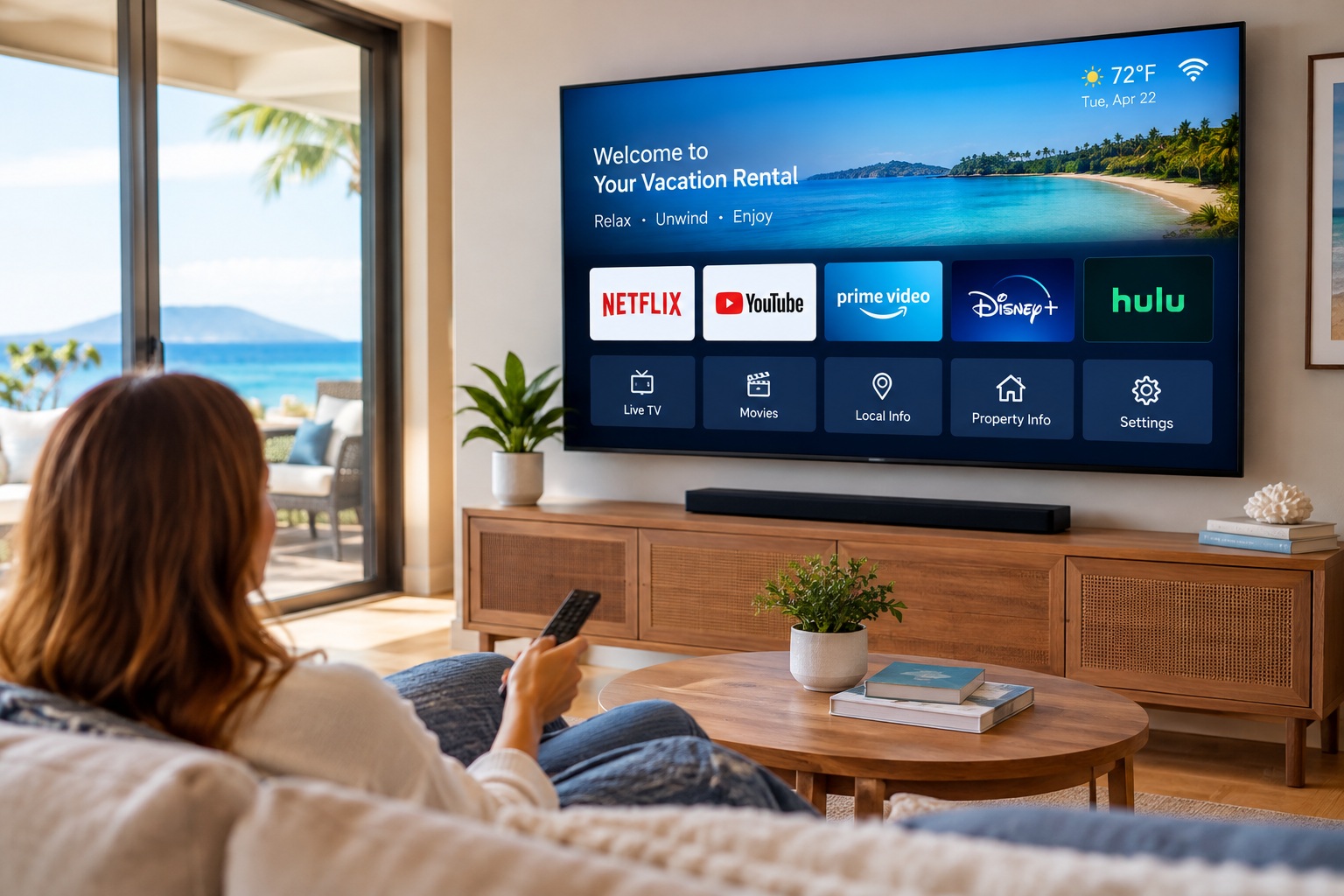
For years, cable TV was a standard part of the vacation rental experience.
Guests arrived, turned on the television, and browsed through a traditional channel guide.
Today, that experience is changing.
Guests are increasingly used to streaming apps, personalized content, on-demand entertainment, and smart TV interfaces in their own homes. When they stay at a vacation rental, they often expect the same level of convenience.
That is one reason traditional cable TV is becoming less practical for modern vacation rentals.
The question is no longer simply:
“Does the property have a TV?”
It’s:
“What can the guest actually do with it?”
What Is Replacing Traditional Cable TV?
Traditional cable delivers a fixed package of channels through a cable provider.
Connected TV takes a different approach.
Instead of relying entirely on a traditional channel package, guests can access streaming services, apps, live channels, games, and other digital content through an internet-connected television or streaming device.
This gives guests more control over what they watch.
For vacation rental owners, it can also create more flexibility in how the TV experience is managed.
1. Guests Are Used to Streaming
People increasingly watch entertainment through streaming platforms in their everyday lives.
They may have their own subscriptions, watch content on demand, or switch between different apps depending on what they want to watch.
Walking into a vacation rental and finding a traditional cable guide can feel very different from the experience they’re used to at home.
Guests don’t necessarily want hundreds of channels.
They want easy access to the content they already know.
That’s a major reason connected TV has become such an important part of the modern guest experience.
2. Cable Offers Less Flexibility
Traditional cable packages are generally built around a predefined selection of channels.
That can work well for some viewers.
But vacation rental guests are different.
One guest may want live sports.
Another may want movies.
A family may want children’s entertainment.
Someone else may simply want to sign into their favorite streaming service.
A connected TV environment can give guests more ways to find entertainment that fits their preferences.
3. Guests Want On-Demand Entertainment
Cable is primarily built around scheduled programming.
Streaming changed that expectation.
Guests can now watch content when they want instead of planning their evening around a television schedule.
That matters in vacation rentals because guests don’t all follow the same routine.
Some may return from an activity at 10 p.m.
Others may stay in after dinner.
Some may wake up early and want entertainment before heading out.
On-demand entertainment fits naturally into those different schedules.
4. Traditional Cable Can Be More Complicated to Manage
Cable isn’t only a guest-facing service.
It’s also something the property owner has to manage.
That can include:
- Monthly service bills
- Equipment
- Cable boxes
- Remote controls
- Service issues
- Channel packages
- Installation
- Technical support
- Multiple accounts across properties
For a single rental, this may be manageable.
For a portfolio of properties, the operational work can become more noticeable.
Modern connected TV solutions can give owners more flexibility in how entertainment and property content are managed.
5. A Vacation Rental TV Can Do More Than Show Channels
One of the biggest changes is that the TV itself can become part of the property experience.
Instead of opening directly to a generic channel guide, a guest could see a personalized welcome screen.
The TV could also provide access to:
- Wi-Fi information
- House rules
- Property instructions
- Local recommendations
- Nearby restaurants
- Attractions
- Streaming apps
- Live channels
- Games
- Other useful guest information
The television becomes more than entertainment.
It becomes a digital touchpoint inside the property.
6. Guests Don’t Want to Figure Out Complicated Technology
There is another important consideration.
Modern technology should make the guest experience simpler, not harder.
A guest shouldn’t have to spend 15 minutes figuring out which remote controls the TV.
They shouldn’t have to search through confusing menus to find basic information.
And they shouldn’t have to understand how the property’s technology works.
The best setup is simple.
Turn on the TV.
See what you need.
Start watching.
Find property information.
Move on with your stay.
7. Streaming Doesn’t Mean Giving Guests Your Personal Accounts
One concern some hosts have about streaming is account security.
Guests may need access to entertainment without gaining access to the owner’s personal accounts.
This is why the way the TV environment is designed matters.
A dedicated guest entertainment system can create a more controlled experience while allowing guests to access supported entertainment services.
Features such as automatic logout and clearing guest information after checkout can also help create a cleaner transition between stays.
The goal is to give guests convenience without creating unnecessary account-management problems for the host.
8. Smart TVs Can Make Properties Feel More Modern
A vacation rental is more than a place to sleep.
Guests evaluate the overall experience.
The way they enter the property, connect to Wi-Fi, find information, use the appliances, and relax at the end of the day all contribute to how the stay feels.
A modern TV experience may seem like a small detail.
But small details can influence how polished a property feels.
A personalized welcome screen can feel more thoughtful than a generic channel guide.
Easy access to streaming can feel more convenient than flipping through channels.
Digital property information can feel more organized than a stack of printed instructions.
9. Cable Is Becoming Less Aligned With How Guests Consume Content
The larger shift is about behavior.
People are moving from:
Scheduled → On-demand
Channel packages → Streaming libraries
One remote experience → App-based entertainment
Generic interfaces → Personalized experiences
Passive viewing → Interactive connected TV
Vacation rentals don’t exist separately from these changes.
Guests bring their everyday technology expectations with them.
The more familiar the property feels, the easier the experience can be.
10. What About Guests Who Still Want Live TV?
Replacing cable doesn’t necessarily mean eliminating live television.
Many guests still enjoy live programming, including news, sports, and other live channels.
The difference is that live content can be delivered through modern connected TV platforms alongside streaming and other digital content.
This creates a more flexible entertainment environment instead of forcing every guest into one traditional package.
The goal isn’t to remove choices.
It’s to give guests more of them.
11. Connected TV Can Be Useful for Hosts Too
The benefits aren’t only for guests.
A modern TV platform can give property owners another way to communicate with guests.
For example, hosts can use the screen to introduce the property, highlight local recommendations, promote amenities, or provide important information.
For owners managing multiple rentals, cloud-based management can also make it easier to maintain a consistent experience across properties.
Instead of treating every TV as a separate piece of equipment, the screens can become part of a larger property management strategy.
12. The TV Can Become a Digital Guest Concierge
Think about the information a guest typically needs during a stay.
Wi-Fi.
House rules.
Check-out instructions.
Restaurant recommendations.
Things to do.
Property amenities.
Entertainment.
Much of that information is already being communicated somehow.
The opportunity is to put it somewhere guests naturally look.
The TV is one of those places.
With a platform like GuestBox, vacation rental owners can use the property TV for entertainment while also providing personalized welcome screens, property information, local recommendations, and other guest-focused content.
That makes the TV useful even when nobody is watching a show.
13. Cable Isn’t Necessarily Disappearing Overnight
Traditional cable still has a place in some properties and households.
The shift is not about every vacation rental suddenly removing cable.
It’s about the changing expectations around television.
As guests become more comfortable with connected devices and on-demand entertainment, traditional cable becomes less essential for many properties.
Hosts now have more options.
And those options can be designed around the way guests actually consume content today.
14. The Future of Vacation Rental TV Is More Connected
The vacation rental TV is evolving.
It can be an entertainment system.
A welcome screen.
A digital guide.
A local recommendation tool.
A communication channel.
And, depending on the platform, even a potential revenue opportunity.
That is very different from simply providing a box that displays cable channels.
The biggest change isn’t the television itself.
It’s what happens around it.
A Better TV Experience Starts With Rethinking the Old One
Cable TV was designed for a different era of television consumption.
Today’s guests are used to more flexibility, more choice, and more personalized digital experiences.
Vacation rental owners don’t have to follow every technology trend.
But they should pay attention to what guests already expect.
For many properties, the question is no longer whether to provide television.
It’s how to make that television experience more useful.
Less channel surfing.
More choice.
Less complexity.
More convenience.
That’s where connected TV is changing the vacation rental experience — and why traditional cable is becoming less relevant for modern properties.